

Table Of Content
- Key Takeaways
- Why Full-Arch Tooth Loss Affects More Than a Smile
- The Main Full-Arch Replacement Options
- Traditional Full Dentures
- Implant-Supported Dentures
- Fixed Full-Arch Restorations
- Fixed or Removable: Which Daily Experience Fits Better?
- What Makes Someone a Good Candidate?
- How Treatment Planning Works
- What Research Says About Implant-Supported Options
- Cost Factors to Consider
- Questions to Ask Before Choosing Treatment
- Daily Care and a Confident Decision
Key Takeaways
- Traditional dentures, implant-supported dentures, and fixed full-arch restorations provide different daily experiences.
- The right treatment depends on oral health, available jawbone, medical history, comfort goals, budget, and maintenance preferences.
- Dental implants can support removable or fixed replacement teeth, but every implant restoration still needs cleaning and professional care.
- A thorough exam and diagnostic imaging are essential before selecting a full-arch solution.
Living with extensive tooth loss can affect more than the way a smile looks. It can change food choices, speech, confidence, and the comfort of everyday routines, whether that means enjoying a meal in the Pearl District, talking with coworkers, or spending time with family around Portland.
People considering full mouth dental implants can review treatment information from Periodontal Associates, a periodontal and implant-focused practice serving Beaverton, Tualatin, and Portland, Oregon. Its page explains full-arch implant treatment, including All-on-4 options, and reflects the practice’s experience with implant surgery, gum health, bone regeneration, and long-term implant maintenance.
Why Full-Arch Tooth Loss Affects More Than a Smile
Teeth help break down food, support clear speech, and provide structure for the lips and cheeks. When many teeth are missing, people may favor one side of the mouth, avoid certain foods, or feel self-conscious while speaking. Remaining teeth can shift into open spaces, and bone changes may occur where teeth are absent.
The Main Full-Arch Replacement Options
Traditional Full Dentures
Traditional full dentures are removable appliances that rest on the gums. They can be a practical non-surgical starting point for people who need to replace an entire arch and prefer a lower initial cost. However, fit can change as the gums and jawbone change over time. Some wearers experience movement while eating or talking, pressure-related sore spots, or a period of adjustment with speech. Relines and adjustments may be needed to maintain comfort.
Implant-Supported Dentures
An implant-supported denture uses dental implants to help retain a removable denture. This approach can provide greater stability than a conventional denture while allowing the patient to remove the appliance for cleaning. It is important to distinguish this option from fixed full-arch teeth. Both may use implants, but a removable implant denture is designed to come out, usually at home, while a fixed restoration remains attached unless removed by a dental professional.
Fixed Full-Arch Restorations
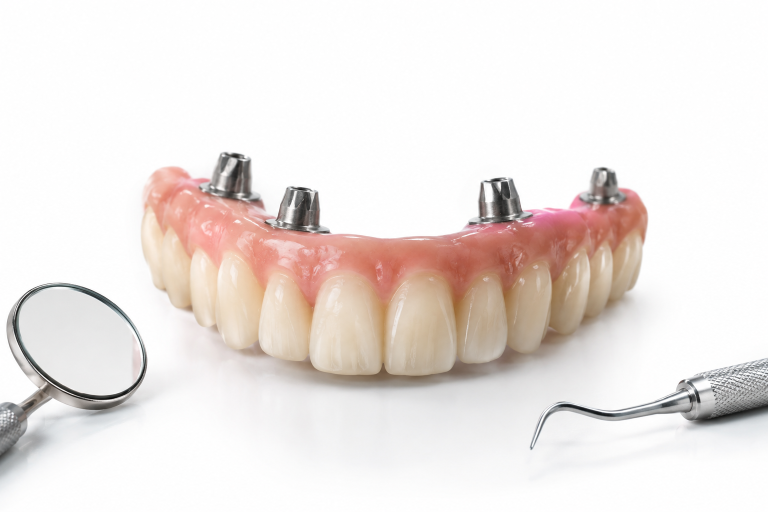
A fixed full-arch restoration replaces a complete row of teeth with a prosthesis secured to implants. For the right candidate, the stable design may make eating and speaking feel more predictable than with a gum-supported denture. Still, fixed does not mean maintenance-free. Patients need to clean around restorations and implants carefully, attend follow-up visits, and report any changes, such as discomfort, bleeding, looseness, or an altered bite.
Fixed or Removable: Which Daily Experience Fits Better?
The best comparison is often not about which option sounds most advanced. It is about how each one fits into ordinary life.
- Eating: A stable implant-supported option may reduce movement during chewing, while removable appliances may require more adaptation with certain foods.
- Speaking: A well-fitting restoration supports speech, but any new appliance can require an adjustment period.
- Cleaning: Removable dentures are taken out for cleaning. Fixed restorations require brushing and tools that clean beneath and around the prosthesis.
- Comfort: Conventional dentures place pressure on gum tissue, while implant-supported options distribute support differently.
- Appearance: Tooth shape, shade, visible gum material, lip support, and smile design should all be discussed before finalizing treatment.
- Convenience: Some people value a restoration that stays in place, while others prefer the simplicity of removing it for cleaning.
What Makes Someone a Good Candidate?
Candidacy cannot be determined by an online checklist. A dental team must assess gum health, remaining teeth, bite, jawbone, medical history, medications, and healing factors. Active gum disease or infection generally needs treatment before implants are placed. Limited bone volume may lead to discussion of grafting or other planning approaches. Smoking and uncontrolled health conditions can affect healing, although controlled medical conditions do not automatically rule out care.
How Treatment Planning Works
- Review health history: Discuss medications, past dental care, current symptoms, and tobacco use.
- Perform a clinical exam: Evaluate gums, teeth, bite, soft tissues, and jaw function.
- Capture diagnostic images: X-rays or three-dimensional scans help assess bone and plan implant placement.
- Compare options: Review whether saving teeth, removable dentures, implant-supported dentures, or fixed treatment makes sense.
- Create temporary and final plans: Discuss what will be worn during healing and how the final teeth will be designed.
What Research Says About Implant-Supported Options
Implant-supported fixed and removable restorations have been widely studied for people without teeth. A systematic review of full-arch implant rehabilitation found that research evaluates outcomes such as implant survival, bone levels, technical complications, function, and patient-reported experience. It also found that study methods vary, which is a useful reminder that no single outcome or treatment design tells the whole story. Long-term results depend on careful planning, healthy tissues, prosthetic design, home care, and maintenance.
Cost Factors to Consider
There is no universal price for full-arch treatment. A personalized estimate may reflect the number of arches treated, tooth removal, infection control, bone grafting, the number and type of implants, sedation needs, temporary teeth, final materials, imaging, laboratory work, follow-up visits, and future repairs. Comparing written treatment plans can help patients understand what is included now and what maintenance costs may arise later.
Questions to Ask Before Choosing Treatment
- Which options fit my current oral health and goals?
- Are any natural teeth worth saving?
- Will my replacement teeth be fixed or removable?
- What happens if my bone volume is limited?
- What should I expect while healing?
- Which cleaning tools and maintenance visits will I need?
- What follow-up care, repairs, or replacements may be needed later?
Daily Care and a Confident Decision
Every full-arch solution requires consistent care. Brush the restoration and gumline as directed, use recommended flossing, interdental, or water-cleaning tools, and keep professional maintenance appointments. Do not ignore bleeding, swelling, pain, looseness, or bite changes. The strongest choice balances four priorities: health, function, appearance, and long-term upkeep. Traditional dentures, removable implant dentures, and fixed restorations can all be appropriate when chosen for the individual rather than for a trend or a marketing claim.