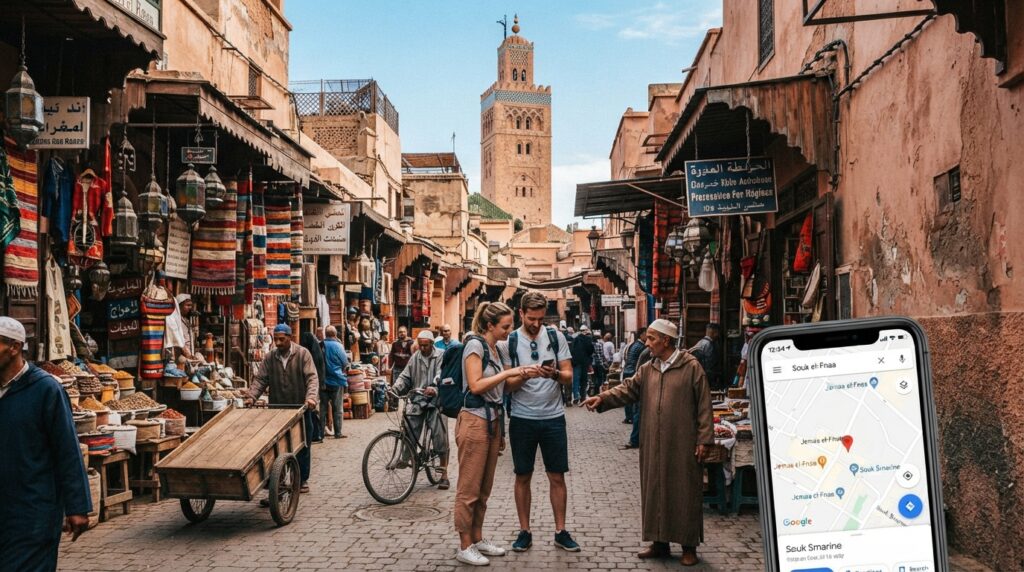
The Marrakech medina is easier to find your way around than it first looks, as long as you keep two fixed points in mind: Jemaa el-Fnaa, the big square near its heart, and the Koutoubia minaret just west of it. Most of the souks lie north of the square, so you can walk north into the markets and come back south to reset.
Table Of Content
The old city was listed as a UNESCO World Heritage Site in 1985. Its clay-and-chalk walls run for about 19 km, with 20 gates and 200 towers, according to the Medina of Marrakesh entry on Wikipedia. Inside, the lanes do not follow a grid, which is why a few landmarks matter more than a street map.
Start at Jemaa el-Fnaa
Jemaa el-Fnaa is the place to begin and the place to come back to when you are lost. UNESCO first proclaimed the “cultural space” of the square a masterpiece of intangible heritage in 2001, and its listing describes storytellers, poets, snake charmers, Berber musicians and Gnaoua dancers, alongside henna tattooing, traditional medicine and food sellers.
The square changes through the day. Orange juice and water sellers work it by day, storytellers and performers gather as evening approaches, and “as darkness falls, the square fills with dozens of food-stalls”, according to the Jemaa el-Fnaa entry on Wikipedia. Seeing it once in daylight and once after dark helps you recognise its edges, which makes the way back easier later.
Landmarks to Find Your Way By
Five landmarks cover most first visits. The table gives their positions as described in Wikipedia’s Landmarks of Marrakesh and Kutubiyya Mosque entries.
| Landmark | Where it is | How it helps |
|---|---|---|
| Koutoubia minaret | About 200 m west of Jemaa el-Fnaa | At 77 m it is visible above the rooftops; local rules keep tall buildings away from it |
| Jemaa el-Fnaa | The main square of the medina | Your base; the souks start on its north side |
| Souk Semmarine | The main souk street, running north from the square | Your main line in and out of the markets |
| Rahba Kedima | A triangular open plaza east of Souk Semmarine | A place to pause and check your position |
| Ben Youssef Madrasa | At the northern end of the souk area, near the Ben Youssef Mosque | A clear target for the far end of a souk walk |
North of the square, Souk Semmarine splits into Souk el-Kebir and Souk el-Attarine. The souks fill the area between Jemaa el-Fnaa and the Ben Youssef Mosque, so if you keep heading north you will reach the madrasa, and if you turn round and head south you will come back to the square.
A Simple First Walk
Take it slowly, with stops for shopping and a glass of mint tea. Each step uses one of the landmarks above.
- Start at the Koutoubia minaret and look at it from the square side. Non-Muslims are not allowed inside the mosque, according to Wikipedia, so this is a view from outside.
- Walk east to Jemaa el-Fnaa and find the entrance to Souk Semmarine on the north side of the square.
- Follow Souk Semmarine north. Where it splits, take either branch and keep going north.
- Look for Rahba Kedima, the triangular plaza to the east of Souk Semmarine, for a break.
- Continue north to the Ben Youssef Madrasa (details below).
- Head back south towards the square, timing your return for the food stalls at dusk.
Ben Youssef Madrasa
The madrasa, a former Islamic college, was built in 1564 and 1565, and its official website lists opening hours of 9:00 to 19:00 every day. Entry costs 50 dirhams, or 10 dirhams for children under 12. The site says its online ticketing is down for maintenance and tickets are sold at the entrance, so bring cash. Its courtyard of carved cedar, marble and stucco is surrounded by about 130 student rooms, according to the landmarks entry.
Other sights for a second day
The Kasbah area holds Bab Agnaou, a late 12th-century gate with a Quranic inscription, and the Saadian Tombs beside the Kasbah Mosque, which hold about sixty members of the Saadi dynasty. The ruins of El Badi Palace and the 19th-century Bahia Palace are both open to visitors. These are easier to reach by asking for each one by name or using a phone map.
Etiquette in the Medina
Ask before you photograph anyone, and expect to pay performers. Travelstart’s Marrakech tips put it plainly: “if you take photos of a market stall or street performer (snake charmers/musicians/people in costume etc), be prepared to pay.” Keep small coins and notes ready for this.
- Bargaining: haggling is normal in the souks. Decide your top price before you start, stay polite, and walk away if it doesn’t work. Once you agree a price, pay it.
- Dress: Travelstart suggests covering knees and shoulders out of respect for local customs. The UK government’s Morocco travel advice notes that women “may receive unwanted attention”, especially when travelling alone, and recommends loose clothes that cover arms, legs and chest.
- Mosques: active mosques such as the Koutoubia are closed to non-Muslims. Look from outside and don’t block doorways at prayer times.
- Taxis: agree the fare before you get in, Travelstart advises; your riad or hotel can tell you a fair price.
Guides, Directions and Staying Safe
Use an official guide if you want one, and be wary of people who offer to show you the way. The UK government says “it is common for people posing as official tourist guides to harass tourists”, and that a guide in a medina should have “an official badge and permission from the local authority”. A firm “no, thank you” is enough for anyone else.
The same advice warns that pickpocketing and bag-snatching are common in tourist areas, especially in medina quarters. Keep your phone and wallet in a front pocket or a closed bag, particularly in the crowds on the square at night.
If you lose your bearings, ask a shopkeeper the way to “Jemaa el-Fnaa” or look for the Koutoubia minaret above the roofs, and walk towards it. Download an offline map before you set out as a backup.
Sources
- Medina of Marrakesh (Wikipedia)
- Jemaa el-Fnaa (Wikipedia)
- Cultural space of Jemaa el-Fna Square (UNESCO Intangible Cultural Heritage)
- Kutubiyya Mosque (Wikipedia)
- Landmarks of Marrakesh (Wikipedia)
- Medersa Ben Youssef (official website)
- 7 tips for travelling in Marrakech (Travelstart)
- Morocco travel advice: safety and security (GOV.UK)