
A home stays cooler without air conditioning when you stop the sun’s heat getting in during the day and let cooler air through at night. Shading, timed ventilation, lighter surfaces and fewer heat sources indoors all help, and most cost little. The advice below comes from government energy and health agencies in the UK, Australia, the US and South Africa.
Table Of Content
Where the Heat Comes From
Sunshine is the main source. The Building America Solution Center says solar radiation is usually the most significant heat source affecting a house, and that shading or reflecting sunlight from the roof and the east and west walls is one of the most effective ways to cut the heat that gets in. The South Australian government adds that a house without insulation gains most of its summer heat through the ceiling and windows.
Some homes heat up faster than others. The UK Health Security Agency (UKHSA) lists top-floor flats, homes with opening windows on only one side, large east, west or south-facing windows without shade, and homes in dense urban areas with little green space. Its list is written for England. South of the equator the midday sun is in the northern sky, and the South Australian guidance tells households there to shade the north and west sides.
Shade Windows Before the Sun Reaches Them
Block the sun outside the glass where you can, because shading works best before heat passes through the window. NSW Climate and Energy Action, a New South Wales government service, says external shading such as shutters and awnings stops the sun’s energy before it passes through the glass, so the window can’t trap heat inside like a greenhouse.
The options it lists include awnings, solar screens that replace insect screens, and shutters or exterior blinds. It says simpler items such as solar screens can often be fitted yourself, while heavier awnings and shutters should go in through a professional so they are fixed safely. Renters should ask the landlord before fitting anything outside.
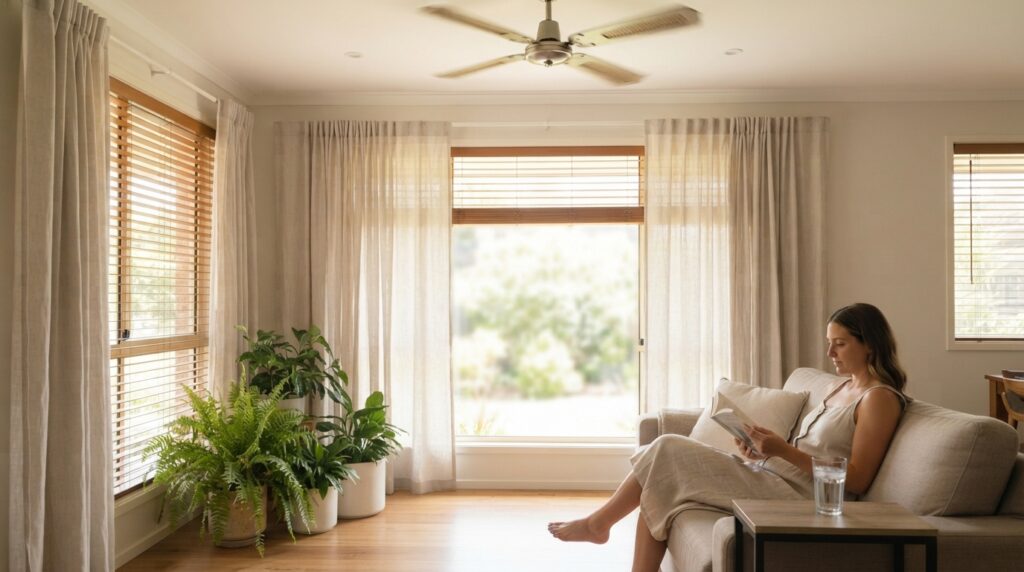
Inside, close curtains and blinds early. The South Australian government advises closing them before the sun hits the window and heats the room, and the UKHSA suggests internal blinds or curtains if you can’t add external shutters or awnings. Leafy trees outside help too: both agencies mention plants as shade.
Ventilate When the Air Outside Is Cooler
Open up when it’s cooler outdoors than in, which in most hot spells means evening and night. The UKHSA says to open windows, when it is safe to do so, when the air feels cooler outside, for example at night. The South Australian government gives the same advice and suggests window locks or lockable screen doors so you can leave openings secure overnight.
Eskom, South Africa’s power utility, also tells households to use natural ventilation by opening windows once it cools down outside. During the day, do the opposite. Lambeth Council in London advises keeping windows that face the sun closed during the day and opening them at night once the temperature has dropped. It also warns that metal blinds and dark curtains can absorb heat.
Air needs a way through. The UKHSA flags homes with windows on just one side as more likely to overheat because air can’t flow across them, so where you have windows on opposite sides, open both and keep inside doors open between them.
Using Fans Safely
Fans move air and help carry heat away, and the South Australian government lists them as the cheapest cooling appliances to run. The UKHSA sets one limit: use electric fans if the air temperature is below 35°C, and don’t aim the fan straight at your body. It also suggests moving to the coolest room in the house, especially for sleeping.
Use Light and Reflective Surfaces
Light colours absorb less of the sun’s energy, so they keep surfaces cooler. The South Australian government says dark colours absorb more light and give it off as heat, the same applies to your roof, and lighter colours are worth considering when you replace or repaint it.
The US Environmental Protection Agency (EPA) reports that cool roofs, which reflect more sunlight than a standard roof, can lower maximum indoor temperatures by 1.2 to 3.3°C in homes without air conditioning. A new roof is a big job and needs a qualified roofer, but the same idea works on a small scale: pale curtains, pale outdoor walls and fewer dark surfaces in direct sun.
Indoors, the South Australian government suggests lifting floor rugs to expose cooler tiles or floorboards.
Cut the Heat Made Inside
Every appliance that runs warms the room a little, so switch off what you aren’t using. The UKHSA says to turn off lights and electrical equipment not in use and to cook at cooler times of day. The South Australian government names chargers, televisions, computers and warm bulbs as heat sources worth switching off.
A Simple Daily Routine
The steps above fit into a routine you can follow through a hot spell:
| Time of day | What to do | Source |
|---|---|---|
| Morning, before the sun hits | Close curtains, blinds and shutters on the sunny side | South Australian government |
| Daytime | Keep sun-facing windows shut and shaded; switch off unused lights and devices | Lambeth Council, UKHSA, South Australian government |
| Cooking | Cook at cooler times of day where you can | UKHSA |
| Evening and night | Open windows when the air outside feels cooler, with locks or lockable screens if needed | UKHSA, South Australian government, Eskom |
| Bedtime | Sleep in the coolest room; use a fan only below 35°C, not aimed at your body | UKHSA |
Longer-Term Fixes Worth Asking About
Ceiling insulation is the longer-term fix both Eskom and the South Australian government point to. Eskom says an uninsulated ceiling warms a house in summer and advises insulating it and checking for gaps around doors and windows. The South Australian government tells renters to talk to the landlord about having insulation installed or topped up, and to use an installer licensed for the work.
Look out for people who struggle in the heat. The UKHSA says older people, especially those aged 65 and over, young children, people who live alone and people with long-term health conditions are at higher risk, and that a hot home can make existing health conditions worse. Checking on an older neighbour during a heatwave is a simple thing to do.
Sources
- UK Health Security Agency: Beat the heat, keep cool at home checklist
- Government of South Australia: Cooling your home
- NSW Climate and Energy Action: External shading of windows and doors
- US EPA: Using cool roofs to reduce heat islands
- Eskom Energy Advisory Services: Stay cool in summer
- Building America Solution Center (PNNL): Design for extreme heat
- Lambeth Council: Keep your home cool