
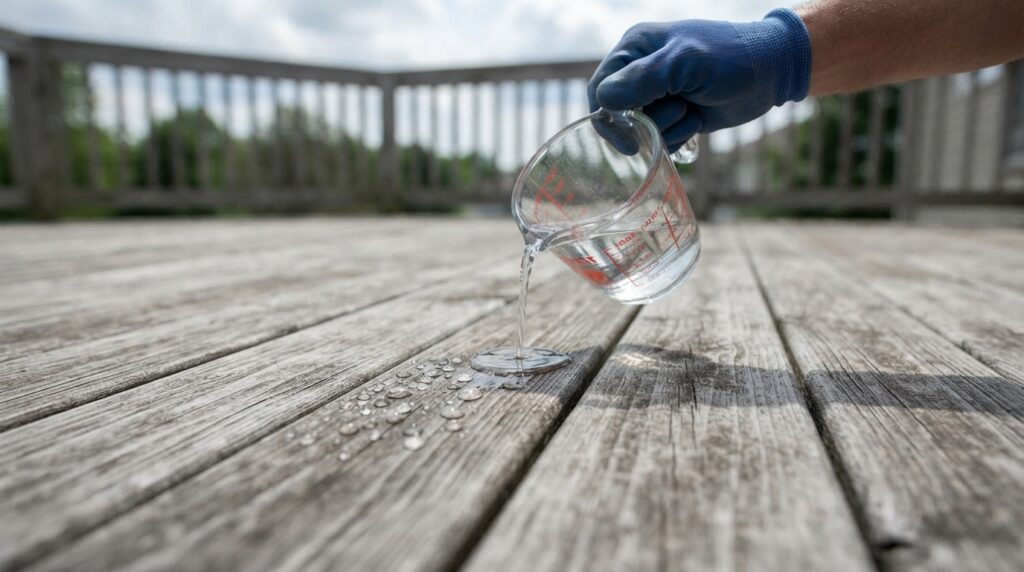
A wooden deck needs resealing when water soaks into the boards instead of beading on top, and a simple splash test tells you which is happening. The job itself is three stages: clean the deck, let it dry, then apply the sealer in the right weather. The timings below come from the manufacturers’ own pages, and the label on the tin you buy always has the final say.
Table Of Content
When Does a Deck Need Resealing?
Reseal when the wood has started absorbing water again. Thompson’s WaterSeal suggests reapplying its waterproofing every two to three years, and says to use its splash test to check whether the surface still needs protection.
Oil-type finishes run on a shorter cycle. Woodoc, a South African wood-care brand, says its Deck Dressing should be reapplied every six months, or when the wood looks dry, and more often on more porous wood.
New wood is a special case. Thompson’s says to wait 30 days before sealing new pressure-treated timber, and points out that pressure treatment protects against insects but does not waterproof the wood.
Do the Water Test
Sprinkle water on the boards and watch what it does for five seconds. Thompson’s WaterSeal describes the test like this:
- Sprinkle water on several different sections of the deck.
- If the water soaks in and darkens the wood within five seconds, the surface is porous and ready to be treated.
- If the water beads up or sits on top, the deck doesn’t need sealing yet.
Test sunny boards, shaded boards and the steps separately, and note any patches that soak up water faster than the rest.
Choose the Right Type of Sealer
Pick a product that suits your wood and how much colour you want, and check it can go over whatever is already on the deck. Thompson’s sells its wood sealers in three levels of colour, and Woodoc splits its deck range by wood type:
| Product type | What it does | Source |
|---|---|---|
| Transparent sealer | Adds subtle colour and shows the most wood grain | Thompson’s WaterSeal |
| Semi-transparent sealer | Adds moderate colour and shows medium grain | Thompson’s WaterSeal |
| Solid colour sealer | Adds the most colour and shows the least grain | Thompson’s WaterSeal |
| Film-forming deck sealer | For soft, porous woods such as pine and meranti; Woodoc’s Deck Sealer gives a low-gloss finish | Woodoc |
| Deck dressing (between an oil and a sealer) | For hard, dense woods such as balau, iroko, kari, teak and saligna; stays soft so it can move with the wood | Woodoc |
Don’t mix systems without checking. Woodoc says its Deck Dressing must go on bare or unsealed wood, and that putting it over old sealer or varnish stops it soaking in, causes drying problems and means it will peel off when the old coat does. Thompson’s suggests trying a colour on a small test area and letting it dry before you do the whole deck, since the final shade depends on the wood.
Clean the Deck First
Scrub the deck with a deck cleaner and let it dry fully before any sealer goes on. Thompson’s method is to apply its Heavy Duty Deck Cleaner with a pump-up sprayer, scrub with a stiff-bristle brush, leave it for 10 to 15 minutes, then rinse. Let the wood dry for at least 24 hours afterwards.
Go carefully with a pressure washer. Thompson’s FAQ warns that it’s easy to damage the wood, leaving a fuzzy surface it calls feathering, or even carving into the boards. If you use one, put the cleaner on first and keep the washer at 1,200 to 1,500 PSI (roughly 83 to 103 bar). The cleaner kills mould, mildew and algae spores that a washer alone leaves behind.
For Woodoc’s oil-type dressing, the brand says to clean with a stiff brush and mineral turpentine before each new application. Wear gloves and eye protection with any cleaner or solvent, and follow its label.
Wait for the Right Weather
Seal on a mild, dry, overcast day. Thompson’s guide says to apply on days between 50°F and 85°F (10°C to 29°C), to avoid very hot weather, and to wait if rain is expected within two days. It calls cloudy days ideal.
Product labels can be stricter or looser than that general guide. The page for Thompson’s Solid Color Wood Sealer asks for surface and air temperatures above 50°F (10°C) during application and for 48 hours afterwards, and no rain forecast within 24 hours. Go by the label of the exact product you use.
Apply the Sealer
Work in small sections so the finish goes on evenly. Thompson’s suggests a brush for trim and edges, a roller for open boards and a sprayer for large jobs, working in sections of about 60 square feet (roughly 5.5 square metres).
- Start at the side furthest from the exit so you don’t box yourself in.
- For Thompson’s Solid Color sealer, one coat is enough; if you want more colour, add a second after about 2 hours and within 4 hours of the first.
- For Woodoc sealers, the brand says a light sanding between coats with fine steel wool is essential, or the finish will be rough.
Coverage depends on the wood. Thompson’s gives 150 to 400 square feet per gallon for its Solid Color sealer, roughly 3.7 to 9.8 square metres per litre, and says actual coverage varies with how porous the surface is.
Drying Times
Thompson’s FAQ says its sealer should be dry to the touch within 2 hours under normal conditions, and the Solid Color product page lists a dry time of 2 to 4 hours. Touch-dry is not the same as ready for furniture, though. The time before you walk on the deck or put furniture back varies by product and weather, so read the tin.
Thompson’s guarantees its Solid Color Wood Sealer for six years on decks. Between resealing jobs, keep using the splash test, and treat any patch that starts soaking up water again.