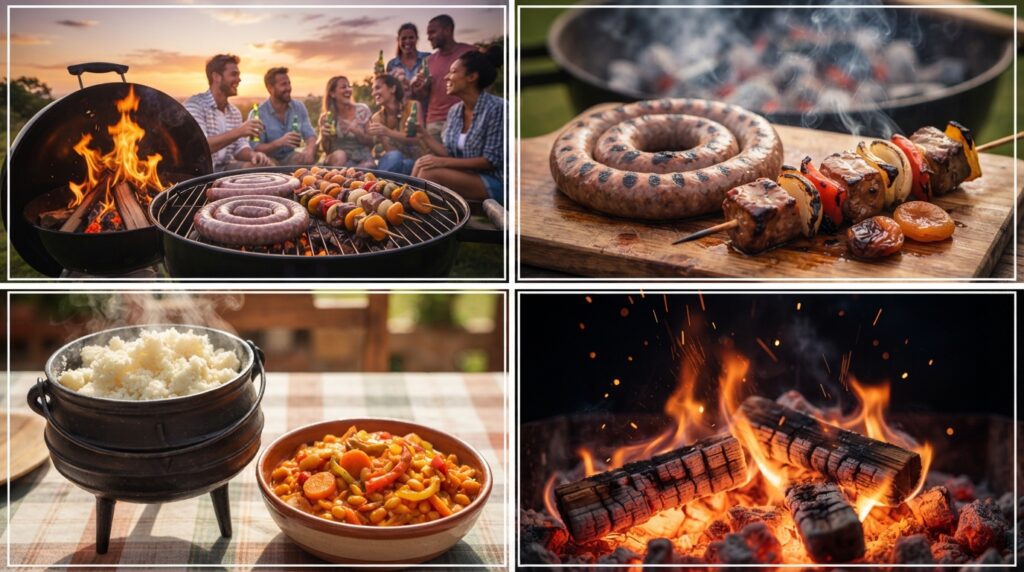
A braai is the South African word for a barbecue, and for the social gathering that happens around it. Meat is cooked on a grid over the hot coals of a wood or charcoal fire, and the meal is as much a social event as a way of cooking. The classic menu is boerewors sausage, sosatie skewers and pap, a maize porridge.
Table Of Content
What a braai is
The word comes from Afrikaans. Wikipedia’s braai article explains that braaivleis means grilled meat (vleis is Afrikaans for meat) and describes the braai as a social custom across much of Southern Africa, not only in South Africa.
There is also an urban version called shisa nyama. Here a butcher sells you the meat and gives you a place to grill it on the spot, per the same article.
Fire or coals: cook over coals, not flames
You light a fire, but you cook over the coals it leaves behind. Both fire guides below start cooking only once the wood has burned down to coals, and the hand test further on tells you how hot those coals are.
Wood, charcoal or briquettes
Wood was the traditional fuel. Wikipedia notes that charcoal, briquettes and gas have become more common because they are convenient. JAN’s guide to braai fuel compares the common South African options:
| Fuel | What it does on a braai |
|---|---|
| Black wattle | Burns slowly, holds heat, adds a smoky flavour and leaves little residue |
| Rooikrans | Called “arguably the most popular” firewood in South Africa; gives very hot coals for searing |
| Blue gum | Burns fast and hot, with low lingering heat afterwards |
| Charcoal or briquettes | Good for fast-cooking cuts such as steak and burger patties; charcoal pieces burn out faster |
Building the fire
Woolworths’ braai fire guide says to always buy dry wood, because wet or freshly cut wood will not burn properly. Its method:
- Lay two pieces of wood parallel to each other and put fire lighters in the gap.
- Lay two more pieces across them at a right angle.
- Repeat the pattern until you have used at least 12 pieces.
- Light it and wait roughly 40 minutes for the wood to burn down to coals.
- Spread the coals evenly with braai tongs and set the grid above them.
Reading the heat with your hand
JAN suggests waiting until the coals are mostly white, then testing the heat by holding your hand about 10 cm above the fire:
- If you have to pull away within 2 seconds, the heat is high.
- At 3 to 4 seconds, it is medium.
- At 4 to 5 seconds, it is low.
JAN also suggests pushing the coals into separate zones, so you can sear on the hot side and move food to a cooler side to finish.
Boerewors
Boerewors means “farmer’s sausage” in Afrikaans. It is a coarsely minced sausage, usually shaped into one continuous coil.
South African rules set what can be sold under the name. According to Wikipedia’s boerewors article, it must contain at least 90 percent meat or fat from beef, pork, lamb or goat, and no more than 30 percent fat. The typical spices are toasted coriander seed, black pepper, nutmeg, cloves and allspice, with vinegar and salt.
It is traditionally grilled over charcoal or wood and often served with pap. In a bread roll it becomes a boerewors roll, or “boerie roll”, often topped with a tomato, chilli and onion relish or chakalaka.
Sosaties
Sosaties are skewers of marinated meat from the Cape Malay kitchen. Wikipedia traces the name to “sate” (skewered meat) and “saus” (spicy sauce).
The usual version uses cubed lamb or mutton, marinated overnight in a mix that can include fried onions, chillies, garlic, curry leaves and tamarind juice. The meat goes onto skewers between dried apricots, red onion and pieces of pepper. They can be pan-fried or grilled, but the braai is the traditional way to cook them.
Pap and other sides
Pap is a porridge made from coarsely ground maize meal, and it is a staple across Southern Africa. Wikipedia’s pap article names three main textures:
- Slap pap: soft and smooth.
- Stywe pap: stiff enough to pick up with your hand.
- Phuthu (uphuthu): dry and crumbly.
At a braai, pap is often served with a tomato sauce or chakalaka, a spicy relish. Wikipedia’s braai article notes that pap with sauce is common inland, while braais on the coast are more likely to include fish and rock lobster.
Braai Day on 24 September
Many South Africans braai on Heritage Day, the public holiday on 24 September. SAnews, the South African Government News Agency, reports that parliament made the day a holiday in 1995 to celebrate the country’s cultural diversity. Before that, 24 September was known as Shaka’s Day, in honour of the Zulu king.
The braai link comes from a campaign. Wikipedia says the National Braai Day initiative started in 2005, was endorsed by the National Heritage Council, and had Archbishop Desmond Tutu as its patron under the name Braai4Heritage. A resident quoted by SAnews put it simply: “For us this is our heritage, it’s a South African thing, we chill together.”
A first braai checklist
If you are hosting or helping at your first braai, this short list covers the basics from the sections above:
- Dry firewood (or charcoal), fire lighters, matches and long braai tongs.
- Time: about 40 minutes for wood to burn down to coals before any meat goes on.
- A grid, and a spot on the fire where coals are thinner for gentler heat.
- Boerewors and sosaties, plus pap with tomato sauce or chakalaka.
- Water or sand close by, and a safe place to leave the coals to burn out after cooking.