
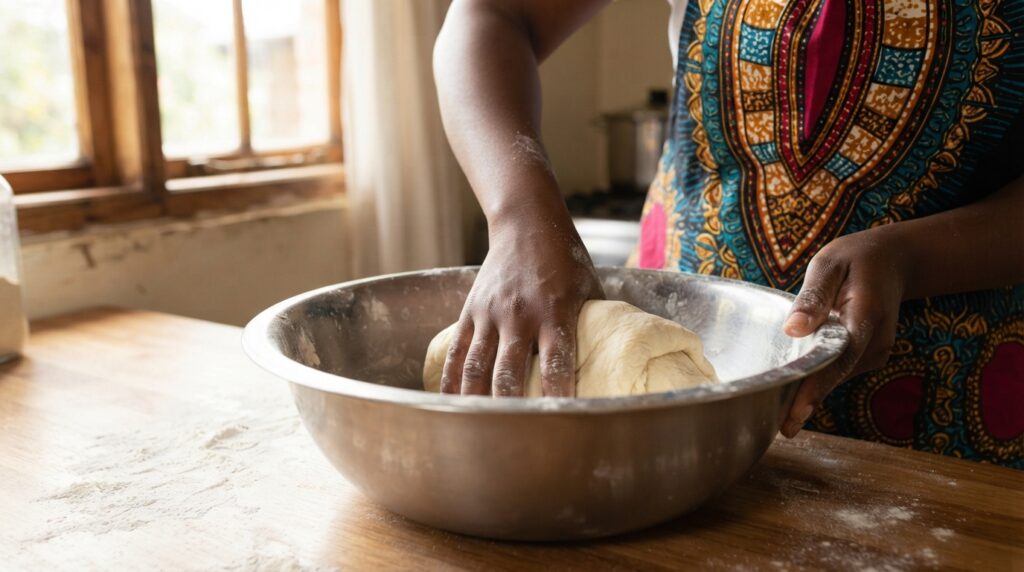
To make Kenyan chapati, you knead a soft dough of flour, warm water, salt and oil, let it rest, then roll each piece thin, brush it with oil and coil it up before rolling it out again. The chapatis are cooked in a dry pan over medium heat and brushed with oil as they cook, which gives them golden spots and soft, flaky layers. Allow about 1½ to 2 hours from start to finish, most of it resting time.
Table Of Content
The method below is written from the techniques shared in the Kenyan recipes of HapaKenya and ToasterDing, with a cross-check against We Eat At Last.
What makes Kenyan chapati different
Kenyan chapati is cooked differently from the South Asian flatbread of the same name. In East Africa it is cooked in a pan with oil rather than baked over a flame, which gives “a soft interior and crispy, browned exterior,” according to Wikipedia’s chapati article. The oiling and coiling step builds the layers.
Wikipedia also explains how it arrived: Indian workers on the railways built under British rule brought chapati to Kenya and Uganda. HapaKenya notes that it has become a common dish at events and a popular street food.
Ingredients (makes 8)
- 3 cups all-purpose (plain) flour, plus a little extra for dusting
- 1 teaspoon salt
- 1 teaspoon sugar (optional)
- 2 tablespoons vegetable oil for the dough
- About 1¼ to 1½ cups warm water
- About ½ cup vegetable oil or ghee for brushing and cooking
These amounts follow the same ratio of flour to water and oil used in the sourced recipes, which range from 2 cups of flour (ToasterDing) to 5 cups (We Eat At Last). Flours absorb water differently, so add the last of the water slowly.
Equipment
- A large mixing bowl and a clean, damp cloth or cling film
- A rolling pin and a floured work surface
- A flat, heavy frying pan or griddle
- A pastry brush or spoon for the oil
Step-by-step method
1. Mix the dough
Mix the flour, salt and sugar in a large bowl. Add the 2 tablespoons of oil and rub it through the flour. Pour in the warm water a little at a time, stirring, until the flour comes together into a rough dough.
2. Knead until smooth
Knead on a lightly floured surface for 7 to 10 minutes. The dough should be soft and smooth and should not stick to your hands. Add a pinch of flour if it is sticky, or a few drops of water if it feels stiff.
3. Let it rest
Cover the dough with a damp cloth or cling film and leave it for 30 minutes. ToasterDing points out that covering the dough stops it losing moisture, which is what keeps the chapatis soft. Its recipe also adds a short second knead and another 30-minute rest, which you can do if you have time.
4. Divide, oil and coil
Divide the dough into 8 equal balls. Take one ball and roll it into a thin circle. Brush the top with oil and dust it lightly with flour.
Now build the layers. Roll the circle up tightly into a rope, then wind the rope round on itself into a flat coil, like a snail shell or a cinnamon roll. Tuck the end underneath. Repeat with the other balls.
5. Rest the coils
Cover the coils and leave them for 10 to 15 minutes. ToasterDing gives the coils this rest so the layers can set before the final rolling.
6. Roll out
Flatten one coil with your palm, then roll it into a circle about 20 cm (8 inches) across and 2 to 3 mm thick. Roll from the centre outwards and turn the dough as you go to keep it round.
7. Cook
Heat the pan over medium heat. ToasterDing warns that higher heat burns the outside before the chapati is cooked through. Then:
- Lay a chapati in the dry pan and cook until small bubbles appear on top.
- Brush the top with oil, flip it, and press it gently with a spatula.
- Brush the second side with oil, flip again, and cook until both sides have golden-brown spots.
Each chapati takes only a couple of minutes. Roll out the next one while the first one cooks.
8. Keep them soft
Stack the cooked chapatis in a bowl and cover them with a cloth or lid. ToasterDing recommends this so they hold their moisture and stay soft until you serve.
Common problems and fixes
| Problem | Likely cause | What to try next time |
|---|---|---|
| Hard or chewy chapatis | Dough too stiff, or not covered while resting | Add a little more water and keep the dough covered |
| No layers | Oiling and coiling step skipped or rushed | Brush each circle with oil and coil tightly |
| Burnt outside, raw inside | Pan too hot | Keep the heat at medium |
| Dry by the next meal | Left uncovered after cooking | Stack and cover them straight from the pan |
The fixes follow the reasons given in the sourced recipes.
What to serve with chapati
In Kenya, chapati is eaten with tea or with stews, according to Wikipedia. ToasterDing lists stews of beans, lentils, beef, mutton and green grams (ndengu), and notes that chapatis are eaten by hand. We Eat At Last suggests Kenyan beef stew, kuku paka (a chicken curry), kachumbari salad and ginger tea.
Across the border in Uganda, chapati is also used as a wrap. An omelette rolled in a chapati is called a rolex, and a chapati with beans is a kikomando, per Wikipedia.