
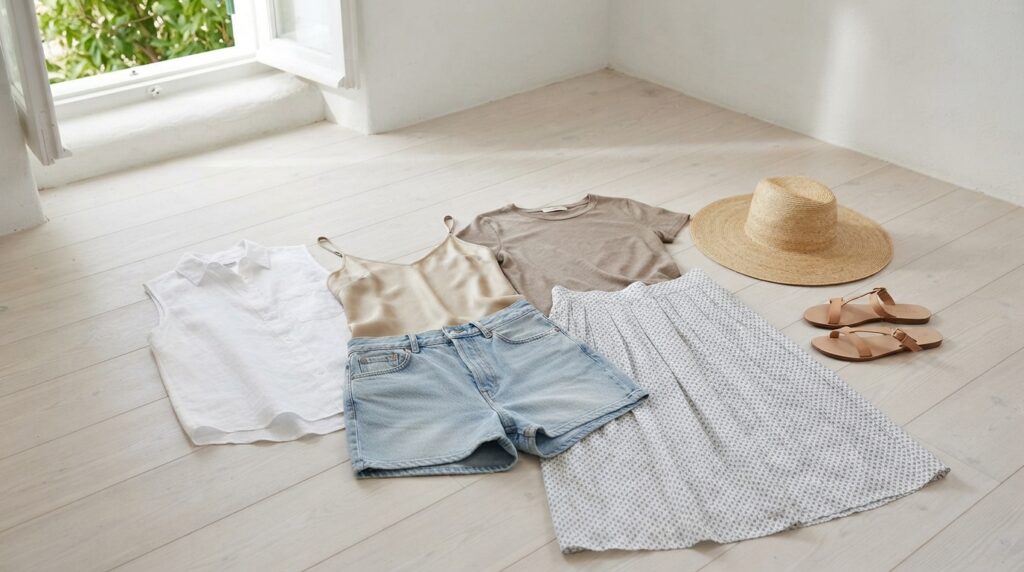
A capsule wardrobe for hot climates is a small set of breathable, light-coloured pieces that all go together, so a dozen or so items give you outfits for weeks. The idea suits life in hot parts of Africa as much as it suits a trip there: fewer clothes, less washing, less deciding. The tricky part is choosing pieces that stay comfortable in real heat, and textile researchers have useful things to say about that.
Table Of Content
Which fabrics work best in hot weather?
Lightweight, breathable fabrics with an open weave work best, and cotton and linen are good starting points. Meredith McQuerry, a professor at Florida State University who studies clothing performance, told the Associated Press: “For greatest airflow, open weave and loose knit structures are best, free of any water- or soil-repellent finishes. Cellulosic fibers, like cotton and flax (linen), tend to be more breathable and comfortable.”
The key, according to George Havenith, emeritus professor of environmental physiology and ergonomics at Loughborough University, is sweat. “The most important thing in the selection of clothing would be to make sure you do not hamper sweat evaporation,” he said in the same report.
Linen
Linen is a strong choice for heat. The Alliance for European Flax-Linen and Hemp, which represents the European flax-linen and hemp industry, says linen “allows more air flow through the fabric, so it feels particularly refreshing” and that it absorbs liquid “instantly and with the widest diffusion”. McQuerry adds a caution: “linen” on the label does not tell the whole story, and how a fabric is woven also affects how easily air passes through it. Holding a shirt up to the light shows how open its weave is.
Cotton
Cotton is comfortable for everyday wear but slow to dry once soaked. Po-Chun Hsu, an assistant professor at the University of Chicago, explained to the AP that cotton works well for a short period until it has absorbed all it can. “Imagine you are wearing a wet T-shirt?” he said. “You won’t feel very comfortable when it’s completely wet.”
Polyester and other synthetics
Synthetics are worth one or two places in the capsule, but only the right kind. Jonathan Chen, a professor at the University of Texas at Austin, said untreated polyester absorbs very little moisture and can feel uncomfortable as sweat builds up, while polyester engineered to move sweat across the fabric helps it evaporate. He suggests looking for lightweight polyester garments designed for breathability. A porous athletic shirt and a dense blouse can behave very differently even if both labels say 100% polyester.
What colours should a hot-weather capsule use?
Choose white and light colours for the main pieces. Hsu told the AP that white, lighter-coloured or highly reflective fabrics can reduce heat gain by reflecting sunlight instead of absorbing as much energy. The NHS heatwave advice likewise recommends “light clothes” along with a hat and sunscreen.
For a capsule, colour also has a practical job: every top should work with every bottom. A simple plan is two or three light neutrals (white, sand, stone or light grey) plus one or two accent colours you like. Darker shades can still have a place for evenings out, when the sun is down.
How should hot-weather clothes fit?
Loose, with room for air to move, for most of the day. Havenith recommends garments with enough room for ventilation, especially outdoors in hot conditions. McQuerry notes that the right fit depends on the activity: “In casual settings, wearers may prefer a looser fit that allows for more airflow while standing or sitting. If performing physical activity, a tighter fit may be preferred to enable quicker sweat evaporation.”
Covering up can also be the cooler choice in strong sun. Havenith said people spending long periods in direct sunlight should prioritise covering skin against UV, and that loose, ventilated clothing such as a lightweight long-sleeved shirt can do this without cutting airflow.
A sample capsule for hot climates
A dozen or so pieces in matching colours cover most needs. This list is a starting point; swap items to fit your work, faith or plans.
| Piece | Fabric to look for | Why it earns its place |
|---|---|---|
| Two or three loose short-sleeved tops | Linen or open-weave cotton | Everyday wear that lets sweat evaporate |
| One lightweight long-sleeved shirt | Linen or light cotton | Sun cover by day, a layer for cool evenings |
| Two pairs of loose trousers or a long skirt | Linen or cotton blend | Covers legs from the sun, works in towns and places of worship |
| One pair of shorts or a knee-length skirt | Cotton | Hot afternoons and rest days |
| One simple dress or a smart shirt | Linen | Dinners and events |
| One or two technical T-shirts | Engineered, breathable polyester | Walking, hiking and exercise; dries faster than cotton |
| A light scarf or wrap | Cotton or linen | Shade for the neck, cover for shoulders, a layer on air-conditioned buses |
| A wide-brimmed hat | Breathable material | Shade for face and neck |
| Comfortable sandals and one pair of closed shoes | Breathable materials | Daily wear and longer walks |
How do you layer when it’s hot by day and cool at night?
Use thin layers you can add or remove rather than one heavy jacket. A day that is hot at noon can still start and end cool, and air-conditioned buses, offices and planes can feel cold.
- Wear the long-sleeved shirt open over a T-shirt in the morning, then roll the sleeves or take it off as it warms up
- Keep the scarf in your day bag for shade, cool air-con or covering shoulders
- Add one light knit or fleece only if your trip includes highlands or desert nights
Watch out for “cooling” labels
Treat “cooling” on a label with care, because many such fabrics only feel cold at first touch. Hsu told the AP that some cooling fabrics are designed mainly to feel cold when they first touch the skin, an effect that fades as the material warms. Unless a fabric increases evaporation, reflects sunlight or improves breathability, he said, “it’s quite unlikely that it will have any continuous cooling effect.”
The safer test is the one researchers keep coming back to: is the fabric light, is the weave open, and does the garment leave room for air? If the answer is yes three times, it belongs in a hot-weather capsule.